
A tennis model is only as good as its time split
A practical guide to chronological validation, match boundaries and data leakage in tennis models, with an illustrative example.
To evaluate a model that will make predictions about future matches, train it on earlier information and test it on later matches. Keep every point from the same match in the same partition. A chronological split is a starting point; it does not, by itself, prove that every feature was available at prediction time.
Start with the prediction moment
Before choosing a model, write down what you want it to predict and when the prediction is made. A pre-match model and a model evaluated after each completed point have different information boundaries.
For a pre-match example, the match result is the label. Player statistics are eligible inputs only if they can be constructed from information available before the prediction. Final match statistics cannot become pre-match features just because they appear in the same historical record.
The same principle applies to preprocessing. Fit an imputer, scaler or feature selector on the training partition, then apply it to later partitions. The scikit-learn guide to data leakage explains why fitting these transformations on the full dataset contaminates evaluation.
Split time, then preserve match boundaries
For an evaluation of future performance, reserve a later period for validation and a still later period for a final test. Do not choose model settings using the final test results.
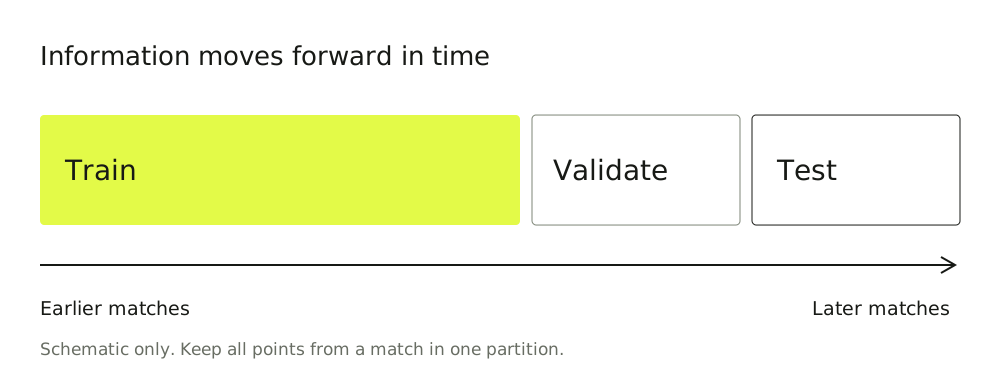
If your dataset contains point rows, split the match table first and join the resulting partition label back to each point. Randomly assigning individual points can put parts of the same match into both training and testing.
For overlapping matches, use a conservative boundary: training labels must be known before the earliest prediction in the next partition. A match start date alone is insufficient if the match continues beyond the cutoff.
A better-looking score can answer the wrong question
Suppose two reports show different classification accuracy. Before comparing them, inspect the split, sample and available inputs. A high score from an inappropriate split may measure a different task from prediction on future matches.
Illustrative data
Same metric, different evaluation questions
% accuracy
| Random point split | 84 % accuracy |
|---|---|
| Chronological match split | 68 % accuracy |
This chart cannot establish that chronological evaluation always lowers accuracy. The useful question is whether the experiment represents the intended deployment conditions.
Make the evaluation reproducible
Record the prediction moment, temporal boundaries, feature availability rules and exclusions alongside the result. The following is an illustrative specification, not an API request or a released dataset contract.
task: pre_match_outcome
partition_unit: match
ordering: prediction_time
training_labels_known_before: validation_start
preprocessing_fit_on: training_only
final_test_used_for_tuning: false
feature_availability: checked_at_prediction_time
| Check | What to record |
|---|---|
| Sample | Match count, date window and excluded records |
| Features | Definition and availability at the prediction moment |
| Baseline | A simpler method evaluated on the same sample |
| Metrics | Definitions, denominators and uncertainty |
| Version | Dataset, feature code and model configuration |
Use more than one time window when the sample allows it. The scikit-learn cross-validation documentation describes time-ordered evaluation. Tennis point data needs additional match grouping; applying a row-based time splitter directly is not a substitute for that boundary.
What this does not establish
A careful split does not prove complete coverage, reliable live inputs or historically accurate availability timestamps. Those require separate evidence. Retrospectively corrected data can differ from what was observable at the time.
Probability calibration and classification accuracy also answer different questions. Choose metrics that match your task, show their definitions and compare methods on the same eligible sample.
Keep the evidence next to the result
Publish enough context for another researcher to understand what was tested. Link the source documentation, explain missing data and label synthetic examples where they appear. If an assumption changes, update the article and its modification date.
For the product's data boundaries, consult our coverage page. For integration details, use the API documentation.
Sources
- scikit-learn: data leakage and recommended practices
- scikit-learn: cross-validation of time series data
Sources checked on 4 October 2026. The tennis-specific grouping advice is an application of these evaluation principles, not a measured experiment.